
US and European Styling of the Mercedes-Benz W113 Pagoda
Like all of the original SL models, the Mercedes-Benz W113 “Pagoda” underwent an evolution, with considerable engineering enhancements as designers mastered new technologies and developed variants for the American market to meet emerging US safety specifications.
One of the most satisfying aspects for clients who commission a classic car restoration at Hemmels is the experience of envisioning the final creation, and then sharing the journey as a new, unique car comes to life. A significant choice in the car we ultimately create is the decision on US or European styling.
Certainly, any paint colour and finish can be applied, complemented by a client’s choice of interior upholstery materials and colours.
While these technologies benefitted all owners, there were specific styling differences to suit the then appetites and safety guidelines of the American and European markets.
Yet advanced safety features were incorporated into the construction of the Mercedes-Benz W113 from the beginning, with the legendary Béla Barényi applying his pioneering ”crumple zones” into the car’s design. Later, the steering was moved and universal joints installed with an aim to making it collapse rather than impale the driver on impact.

Hemmels restored Mercedes-Benz 280SL with padded steering wheel centrepiece
The steering wheel itself was offset with a padded “donut” in the middle to cushion further impact.
For the US market, the Mercedes-Benz W113 Pagoda was given two distinct modifications to give the car a distinctly American look.
US and European Mercedes Benz W113 Pagoda: Different Headlights
The headlamp array was significantly altered to have the turning indicators underneath the main headlight, in keeping with the common design practice of the big four manufacturers in Detroit, and the US safety guidelines of the period.

Hemmels-restored Mercedes-Benz W113 280SL Pagoda European styling headlights and front bumper

Pre-restored American US Mercedes-Benz W113 280SL US spec headlights and Front bumper overriders
Further, the headlight itself was changed to accommodate the standard sealed bulb, built to the specification of an easily (and cheaply) replaceable part that could be sourced from any US auto parts supplier. In the 1960s the life of a sealed beam headlight was a fraction of its modern equivalent, with the original lasting about 400 hours on average, however the good news was that because a standard size was produced en masse to fit many makes and models, the replacement cost was was minimal.

Pre-restored American US Mercedes-Benz W113 280SL US spec headlight and Front bumper overrider and side marker

Hemmels-restore Mercedes-Benz W113 280SL European spec headlight
Today we cherish the Mercedes-Benz W113 Pagoda as classic car above most others, however it was originally launched and positioned as a practical, all-weather car, albeit one for executives who could afford a step-up in quality and style. The Pagoda was used year round as a daily driver, its bullet-proof reliability encouraging frequent usage.

Pre-restored American US Mercedes-Benz W113 280SL rear bumper overriders and side marker
Consequently, the reflective strength of the US headlamp never diminished with the passage of time, as the sealed beam enclosure, was never affected by long term oxidation. The European version was comprised of replaceable bulbs that reflected off a separate parametric reflecting bowl, much like the US cars before the 1960s. The US automakers knew that over many year the reflecting bowl would dull and decrease the strength of the beam. This was not a significant issue on the Pagoda dues to the superior metal alloy used, however Mercedes-Benz complied with the standard sealed-beam fitting nonetheless.
The American headlamp styling for the Mercedes-Benz W113 Pagoda also incorporated a more prominent turning signal indicator as well as side markers. Again, these design changes were largely to meet USA safety guidelines. Not that these changes were introduced in the late 1960s and affected the 280SL. The Mercedes-Benz 230SL and 250SL variants
Worth a mention is the change in colour of the rear tail lights from just red, to a red / amber glass. The changesto the tail light assembly first changed in Germany, again to comply with new safety requirements, with changes to cars destined for the US and other geographical markets phased in over time.
The final visual alteration for the Mercedes-Benz W113 Pagoda was to the bumpers themselves. To meet US safety standards, overriders with rubber facings became mandatory on the later Pagoda models. One of the unforeseen advantages some 60 years later is the ability to discreetly install modern parking sensors and rear cameras, just some of the options available to Hemmels clients.

Pre-restored American US Mercedes-Benz W113 280SL US spec rear bumper overriders and rear side marker

Hemmels-restored European Mercedes-Benz W113 280SLrear bumper with amber and red taillight.
US and European Mercedes Benz W113 Pagoda: Interior Changes for America
Being manufactured in Europe, speedometers were naturally in kilometres per hour, hence the instrument and associated cable gear needed to be changed to MPH for the USA and other markets that used imperial standards.
Yet the biggest change to the interior of the Mercedes-Benz W113 Pagoda throughout its lifespan was the makeover to comply with US safety guidelines. The crisp, angular dashboard and other distinct protrusions were replaced with softer, rounded edges. Hard-pockets on the doors were replaced with ruched pockets, and the coloured plastic heater controls were replaced with rubber equivalents.

Pre-restored Mercedes-Benz W113 280SL American US spec rear bumper and overriders
In addition, some door furniture was replaced. The original door opening handle and the locking lever were changed from a round design to a more rectangular version. Whether this was done as a safety concern or simply a styling change s unknown, tough there was definitely an emerging trend towards rectangular and curve-less cars by the early 1970s.
US and European Mercedes Benz W113 Pagoda: The California Coupe
It is no secret that in late 1950s Daimler-Benz saw the USA as a key market to win due to its post-war affluence and new love affair with car. Whilst Europe was coping with a rebuild, Americans were becoming wealthy, with multiple cars in their driveways. There was a definite demographic that desired European quality with “old country” class.
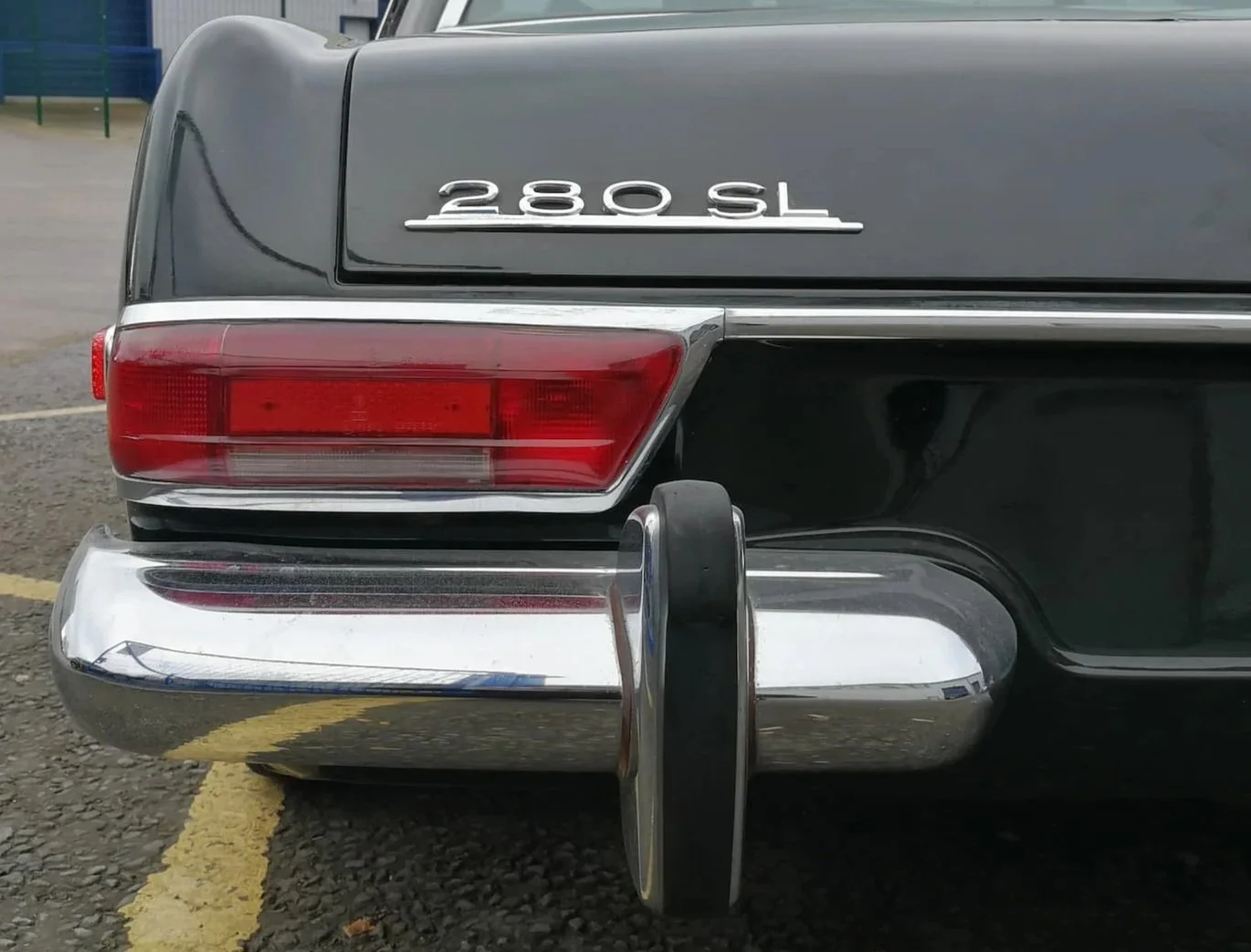
Mercedes-Benz 280SL All Red Tail Light
In 1967 the Mercedes-Benz “California Coupe” was launched, which introduced a rear seat to make the car a 2 + 2 convertible. The rear seat came at the cost of the soft top compartment and closing panel however, and though it enjoyed modest sales it failed to impress and was phased out of production.
US and European Mercedes Benz W113 Pagoda: Which Styling Better?
The changes to the American version of the Mercedes-Benz W113 were mainly driven by the need to comply with US safety standards of the time. Today clients are free to have their Pagoda created to either the US or European design, with modern enhancements and modifications.
The vast choice of options, colours and styling can be overwhelming, however the good news is that clients can take their time in selecting each of these, usually well into the production timeline of their car.

Hemmels-restored Mercedes-Benz W113 280SL Pagoda: There are no side markers on the European Pagoda.
It may come as a surprise that ,during the restoration process, the decision of US or European headlights comes sooner than expected. At the early stages of body fabrication each chrome piece is test-fitted to ensure a perfect installation after the body is primed and painted. One must remember that these cars were largely built by hand with panels not built by robots but rather man-operated presses. Each component has its unique profile, and it takes a personal touch to ensure each chrome item – including headlamp bezels and surrounds – fit without a flaw.
However, precision engineering and the pursuit for perfection are the basis of the Hemmels ethos, and the passion of each of our craftsmen and women.

Whether you choose an American or European styled Mercedes-Benz W113 Pagoda, Hemmels will create a unique classic, exactly as you have dreamed.